
The Evolution of Chaos: How Asymmetrical Balance and Physics-Engine Volatility Defined Who’s Your Daddy?!
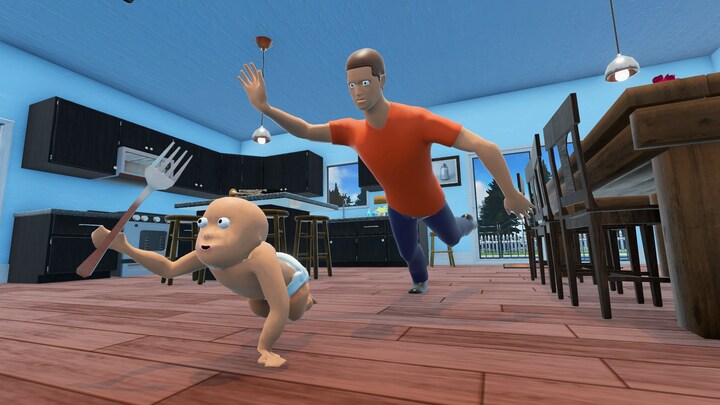
The indie gaming boom of the mid-2010s was characterized by a distinct subgenre of sandbox titles that prioritized emergent comedy over polished mechanics. Among these, Who’s Your Daddy?!—conceived by Joseph Williams under Evil Corp Games and launched via Kickstarter before taking Steam by storm in late 2015—stands out as a quintessential case study in asymmetrical multiplayer design. The game’s premise is straightforward yet absurd: one player assumes the role of a hyper-vigilant Father attempting to baby-proof a suburban home, while the other plays as an infanticidal, ragdoll Baby actively attempting to end its own life using household hazards. Beneath its simplistic control scheme and low-poly aesthetic lies a delicate, often chaotic balancing act between physics engine mechanics, spatial control, and player agency.
To understand Who’s Your Daddy?! as more than a viral meme game, one must examine the specific systemic issue that has governed its development, player community, and game longevity: the tension between deterministic mechanics and physics-driven unpredictability. Over its lifecycle—spanning its original Steam Early Access build, iterative patch cycles, full release, and the expansive 2023–2024 remake updates—the developers have constantly struggled to balance competitive fairness with the volatile ragdoll physics that made the title famous. This article analyzes how the interaction between game physics, spatial design, asset interactions, and asymmetrical power dynamics created an unscripted meta-game that evolved from an erratic simulation into a structured, highly strategic tug-of-war.
In its initial 2015 alpha release, Who’s Your Daddy?! offered a raw, almost uninhibited environment where the physics engine operated as an unguided catalyst for hilarity. The core loop was established on a foundation of stark structural asymmetry. The Daddy player was granted high movement speed, a wide field of view, and the functional ability to interact with safety equipment such as cabinet locks, outlet covers, and health pills. Conversely, the Baby player was given slow, low-to-the-ground locomotion, an unpredictable crawling momentum, and the capability to consume or interact with environmental hazards ranging from bleach bottles to exposed electrical outlets.
During this inaugural phase, the systemic balance heavily favored the Baby due to what early players termed "environmental saturation." The sheer density of lethality within the single-story suburban house meant that the Daddy was perpetually reactive rather than proactive.
Because the original game lacked inventory caps for the Baby and featured zero cooldowns on hazard consumption, a Baby player could consume a toxic bottle of glass cleaner within fractions of a second upon entering a room. The Father, constrained by physical pickup animations and a limited inventory capacity, spent the majority of matches executing delayed damage mitigation rather than genuine prevention.
Furthermore, the initial collision boundaries (hitboxes) of the environment were remarkably primitive. Objects dropped by the Daddy would frequently clip through tables, doors, and walls, inadvertently creating new hazard paths or blocking key doorways. This structural instability created a meta where winning as the Father relied less on tactical awareness and more on exploiting glitch physics—such as wedging heavy furniture against doors to trap the Baby in a "safe zone."
Structural Discrepancy Matrix: Initial Release Phase
- Daddy Capabilities: 100% Movement Speed, Door Locking, Outlet Capping, Pill/Item Administration, Trash Can Securing.
- Baby Capabilities: 65% Base Crawl Speed, High-Velocity Ragdoll Launch, Immediate Hazard Ingestion, Object Throwing, Vent Crawling.
- Primary Environmental Hazards: Bleach, Drain Cleaner, Wall Sockets, Bathtub Water, Glass Tables, Ceiling Fans, Gas Stoves.
Early Physical Exploits
- The Socket Snap: Rapidly crouching near a wall outlet allowed the Baby to clip through the Father's interaction hitboxes, securing an instant electrocution before an outlet cover could be rendered.
- Bleach Hoarding: Picking up multiple toxic items sequentially to stack damage-over-time status effects faster than health pills could neutralize them.
- Vent Stacking: Jamming small props into air vents to lock the physics engine into a loop, propelling the Baby across the map at supersonic speeds.
The structural identity of Who’s Your Daddy?! is inextricably linked to the Unity engine's PhysX implementation, specifically its rigid-body dynamics and jointed ragdoll behavior. When the Baby sustains damage—whether from falling, electrocution, or impact—its character model transitions from a keyframed crawling animation to an unconstrained ragdoll simulation. In early iterations, this transition was fraught with unintended momentum transfers, often catapulting the Baby across the living room upon receiving minor force vectors.
While these physics anomalies provided the game with its viral social media appeal, they introduced severe competitive instability. A Baby player could intentionally trigger a high-velocity ragdoll state by jumping off a couch into a ceiling fan, using the resulting impact momentum to fly directly into an un-capped kitchen outlet on the far side of the house. What was intended as a penalizing damage state effectively became the game's fastest mode of transportation.
The computational strain of real-time multi-body collisions also led to severe network desynchronization (desync) in peer-to-peer multiplayer matches. On the host's client, the Father might successfully grab the Baby out of mid-air; on the joiner's client, the Baby had already ingested a battery and hit the floor. This divergence between server state and client rendering highlighted the double-edged sword of relying on physics-heavy interaction in a low-budget network environment.
Mechanics of Ragdoll Momentum Conservation
- Mass Ratio Disparity: The Baby's in-game mass was set extremely low to allow easy lifting by the Father, which inadvertently multiplied external forces applied to it by household props.
- Joint Velocity Stacking: Rapid rotation of ragdoll limbs upon collision repeatedly calculated additive velocity vectors, leading to physics "explosions."
- Raycast Misses: High-speed ragdoll movements frequently bypassed single-frame collision detection (CCD), pushing the character model inside static geometry.
Physics-Engine Divergences Across Build Versions
- Alpha Builds (2015): Uncapped physics tick rate; extreme object clipping; velocity stacking enabled map escapes.
- Early Access Patches (2016–2017): Implemented Continuous Collision Detection; reduced ragdoll momentum scaling; introduced hard boundaries around room perimeters.
- Remake Engine Update (2020+): Custom physics solver implemented; ragdoll state decoupled from raw velocity to prevent physics-based fast travel.
As players logged hundreds of hours into the original suburban house map, the meta shifted from chaotic wandering to rigid spatial control. Who’s Your Daddy?! ceased to be a simple game of hide-and-seek and evolved into a territory control simulation. The Father’s primary objective became the establishment of "safe sectors"—zones where all immediate hazards were either locked away, consumed, or rendered inert—while the Baby sought to break through these defensive perimeters.
The suburban house layout features clear spatial hierarchies: high-risk zones (Kitchen, Bathroom, Garage) containing concentrated, highly lethal hazards, and low-risk transit zones (Hallway, Living Room) that serve as mobility hubs.
A competent Father player would execute an optimized opening route: sprint to the kitchen, cap the three low-level outlets, secure the cabinet under the sink containing bleach, and lock the basement door. This route aimed to turn the central living space into a sterile environment where the Baby could roam without causing immediate fatal self-harm.
Conversely, the Baby’s spatial strategy relied on "zone overloading." By using vents, doggy doors, or window ledges, the Baby could bypass the Father’s defensive chokepoints and enter a high-risk zone unmonitored. Once inside a room like the Garage—which contained car exhaust hazards, power tools, and lawn chemicals—the Baby could initiate multiple lethal vectors simultaneously, overwhelming the Father's ability to respond.
Key Tactical Rooms ranked by Hazard Density
- The Kitchen: Highest threat level. Features a gas stove, microwave, wall sockets, chemical cabinet under the sink, and sharp utensils.
- The Master Bathroom: Extreme short-term threat. The bathtub represents an instant drowning hazard if filled, alongside medicine cabinets and electrical outlets near water sources.
- The Garage: High delayed threat. Contains a running vehicle (carbon monoxide hazard), gasoline cans, and high-tier physics props capable of blunt-force damage.
- The Living Room: Neutral territory. Limited hazards (television tipping, glass tables, single outlets), serving primarily as a speed-check corridor for spatial control.
Standard Father "First-30-Seconds" Routing
- 0:00 - 0:10: Secure Cabinet Locks from the master bedroom closet; cap Living Room outlets.
- 0:11 - 0:20: Lock Kitchen sink cabinet; apply lock to the oven dial; remove fork from table.
- 0:21 - 0:30: Close and lock Garage access door; deploy Baby Monitor in central hallway.
Damage in Who’s Your Daddy?! is not uniform; it is categorized into specific vectors, each operating under distinct mechanical rules. Understanding how these damage systems calculate health loss over time (DoT) vs. instant lethal impact is fundamental to analyzing the game's internal balancing mechanisms.
The Ingestion System governs chemical hazards. Bleach, drain cleaner, and misapplied prescription medications fall into this category. When ingested, these items apply a status effect that tick-drains the Baby's health bar over a set duration. The mechanical counter to chemical ingestion is the Daddy's inventory of Health Pills or Antidotes. This dynamic created an internal resource economy: the Father had to maintain a precise count of available medicine relative to the number of un-secured toxic containers remaining on the map.
Thermal and Kinetic hazards, on the other hand, operate on spatial proximity and physics collision thresholds. Thermal hazards (standing on a lit stove burner or climbing inside an active oven) deal linear tick-damage that accelerates if the Baby remains within the flame trigger box. Kinetic hazards (falling from top shelves, getting struck by ceiling fan blades, or tipping heavy furniture) calculate damage using the velocity of the impact vector.
Mathematical Breakdown of Core Hazard Types
- Bleach Ingestion: $-5\text{ HP/sec}$ for $15\text{ seconds}$ (Total: $75\text{ HP}$). Requires $1\times\text{ Antidote}$ to purge status effect.
- Wall Socket Electrocution: Instant $-35\text{ HP}$ burst + $3\text{ second}$ stun lock. Continuous contact causes additional $-10\text{ HP/sec}$.
- Bathtub Submersion: Oxygen meter decays over $8\text{ seconds}$. Once depleted, deals $-20\text{ HP/sec}$ drowning damage.
- Glass Table Shatter Impact: $-15\text{ HP}$ base damage + floor shrapnel zone dealing $-2\text{ HP/sec}$ foot abrasion upon movement.
Status Effect Interactions
- Pill Overdose: Administering pills when the Baby is at full health triggers a poison effect, dealing $-2\text{ HP/sec}$ due to toxicity.
- Flammable Ingestion + Fire: If the Baby ingests gasoline and subsequently touches an open flame, the internal tick damage is doubled instantly.
- Water + Electricity Coupling: Submerging an active toaster or appliance into a filled bathtub converts the entire water body into a continuous death-zone trigger.
The strategic depth of Who’s Your Daddy?! expands significantly through its item economy. Both players must manage an inventory system, but their tactical objectives for item usage are diametrically opposed. The Father collects preventative and corrective utilities, whereas the Baby hunts for lethal consumables and mobility enhancers.
In early updates, items spawned in semi-static locations, enabling high-tier players to memorize spawn nodes and execute deterministic item runs. To break this predictable pattern, the developers implemented a randomized loot tables system across drawers, cabinets, and closets. This change forced both players to adapt their routing dynamically on a match-by-match basis.
The resource dynamic is further complicated by item weight and interaction speeds. The Father can carry multiple large items simultaneously but suffers slight movement speed penalties if carrying heavy props like trash cans or wood planks. The Baby features a tiny inventory grid, forcing the player to choose between holding a high-damage consumable (bleach) or a key utility item (a fork to jam into outlets or keys to open locked doors).
Key Item Categories and Strategic Utility
- Locking Mechanisms (Father Only): Placed on cabinets, fridges, and doors. Consumes a finite resource stack. Requires the Baby to find a lockpick or execute a prolonged noise-making break-in interaction to bypass.
- Detection Tools (Father Only): The Baby Monitor acts as an environmental camera sensor, broadcasting video feeds of specific rooms to the Father’s UI hud, offsetting his spatial blind spots.
- Conductive Objects (Baby Focus): Forks, paperclips, and keys allow the Baby to shock itself at capped or uncapped sockets, bypassing standard outlet cover protections if not monitored.
- Mobility Buffs (Shared/Baby): Consuming energy drinks or certain candy items boosts crawling speed by up to 50% for a short duration, allowing rapid traversal across open hallways.
Inventory Management Constraints
- Father Inventory Limits: 4 Standard Utility Slots, 1 Heavy Prop Carry Slot (Requires dual-handed hold).
- Baby Inventory Limits: 2 General Carry Slots, 1 Mouth/Ingestion Slot (Triggers ingestion timer upon pickup if consumable).
- Item Respawn Dynamics: Non-consumable props do not respawn upon destruction; consumable items are capped per map instance to prevent infinite healing/poison loops.
As the viral novelty of Who’s Your Daddy?! settled into a stable, dedicated player base between 2016 and 2018, Evil Corp Games faced a crucial developer crossroad: maintain the broken, meme-heavy physics state or aggressively patch the title toward systemic balance. Choosing the latter path, a series of updates systematically reworked core interactions to address the extreme advantage held by skilled Baby players.
The first major balancing initiative targeted the Baby's self-harm speeds. The time required to drink toxic liquids was scaled up, introducing a readable "drinking animation" and audio cue that gave nearby Father players a reaction window to intervene and slap the item away.
Additionally, the patch era introduced the "Daddy Power" system. To reward Father players for performing active parenting tasks—such as putting away scattered toys, replacing battery covers, or closing open cabinet doors—the game awarded Father Points. These points could be spent to activate map-wide perks, such as revealing the Baby’s outline through walls for 5 seconds or gaining an instantaneous sprint boost.
Chronological Patch Milestones (2016–2018)
- Build 1.1.0 (The Audio & Vision Patch): Added distinct sound propagation for crawling, drinking, and opening doors. Implemented visual outlines for vital items.
- Build 1.3.0 (The Power Up System): Integrated Father Points system; gave Father active abilities to offset spatial awareness gaps.
- Build 1.5.0 (Hazard Rework): Converted instant-kill hazards (e.g., glass table shrapnel, ceiling fan drops) into scaled damage-over-time triggers.
- Build 2.0.0 (Pre-Remake Consolidation): Standardized network tick rates to 60Hz, significantly mitigating client-side ragdoll desync issues.
Comparative Balance Metric Across Eras
Game EraFather Win Rate (Community Est.)Baby Win Rate (Community Est.)Primary Cause of Match TerminationAlpha (2015)~20%~80%Instant Bleach Drinking / Socket ClippingMid-Early Access (2016)~40%~60%Unlocked Garage / Vehicle ExhaustLate Patch Era (2018)~50%~50%Timed Health Depletion vs. Full Cleanup
In late 2020, Evil Corp Games announced a ground-up remake of Who’s Your Daddy?!, built on an updated custom engine setup in modern Unity. Released progressively through 2023 and expanded heavily into 2024, this remake was not merely a graphical upgrade—it represented a complete architectural redesign of the game’s core systems, map layouts, character classes, and interaction physics.
The primary objective of the remake was to transition the game from a single-house sandbox into a expandable, multi-environment platform featuring custom game modes, expanded player lobbies (up to 4v4 matches), and distinct character skins with unique passive attributes.
The environmental scale was drastically enlarged. The classic house was replaced with an expanded, multi-story estate complete with a backyard pool, extended attic space, home gym, and complex electrical grid controls. These structural changes disrupted long-established player strategies, forcing the community to re-learn spatial defense and attack routes under a far more dynamic physics model.
Key Technical Enhancements in the Remake
- Dedicated Server Architecture: Replaced legacy P2P networking with dedicated authoritative servers, removing client-side hit registration exploits.
- Custom Physics Solver: Rewrote character collision handling to preserve funny ragdoll momentum without allowing out-of-bounds clipping or fast-travel exploits.
- Modular Map Generation: Introduced randomized door locations, alternate vent shafts, and variable appliance layouts per match round.
- Multi-Baby Scaling: Rebalanced hazard damage calculations to accommodate games with multiple Baby players simultaneously targeting different areas of the house.
Comparative Feature Matrix: Original vs. Remake
- Max Players per Match: Original = 2 (1v1) | Remake = Up to 8 (Multi-Father / Multi-Baby setups).
- Playable Maps: Original = 1 (Standard House) | Remake = Multiple (Remade House, Heavy Industrial, Winter Estate, Outdoor Park).
- Interaction Model: Original = Direct Raycast Trigger | Remake = Physics-based Contextual Radial Menu + Hold Animations.
Despite its casual appearance, Who’s Your Daddy?! developed a dedicated high-level community that codified optimal strategies, precise movement techniques, and execution routings. In high-skill matches, the game plays out with high-apm (actions per minute) efficiency, where split-second decisions dictate victory.
For the Baby, the meta revolves around "hazard chaining" and "feints." An experienced Baby player will deliberately make noise in the Bathroom (filling the tub) to draw the Father away from the Kitchen, only to double back through a vent to access a pre-unlocked cabinet containing drain cleaner.
For the Father, the advanced meta relies heavily on "predictive denial." Rather than reacting to where the Baby currently is, top-tier Father players secure rooms based on spawn probability matrices and route efficiency. They drop essential recovery items (pills, batteries) in a centralized neutral zone (e.g., the central hallway table) to create a forward operating base, minimizing travel time when treating damage.
Advanced Mechanics Executed by Veteran Players
- Item Juggling (Daddy): Carrying two essential heavy items simultaneously by rapidly dropping and picking them up while moving forward, effectively bypassing the single-prop carry limit.
- Ragdoll Canceling (Baby): Entering and quickly exiting the ragdoll state mid-air to reset fall-damage velocity calculations, allowing safe jumps from high places to reach lower floor hazards faster.
- Vent Blockading (Daddy): Positioning large static props like couches or heavy planters directly in front of vent exits to permanently lock down the Baby’s fast-travel network.
- Socket Overcharging (Baby): Intentionally triggering multiple wall sockets in rapid succession to trip the house breaker, plunging the map into darkness and limiting the Father’s visual field.
Structural Counterplay Loop
- Baby Strategy: Vent Flanking $\rightarrow$ Father Counter: Door Capping / Vent Blockading.
- Father Strategy: Centralized Pill Stashing $\rightarrow$ Baby Counter: Stealing/Hiding Pills in inaccessible locations (e.g., behind furnace).
- Baby Strategy: Mass Water Submersion (Drowning) $\rightarrow$ Father Counter: Main Water Valve Shutoff (Remake Mechanic).
The systemic success of Who’s Your Daddy?! is inextricably linked to its unique psychological framework. Unlike symmetrical competitive games where both sides share identical victory conditions and moral framing, this title establishes a core asymmetry of tension: one player experiences pure anxiety and task management, while the other experiences playful destruction and spatial exploration.
This dynamic creates a distinct psychological asymmetry that dictates player decision-making. The Father operates under a continuous mental load composed of time management, environmental vigilance, and triage response. His psychological state is defined by a expanding list of chores that must be completed before an impending disaster occurs.
Psychological Load Distribution Metrics
- Father Task Frequency: High (10–15 discrete environment interactions required per minute).
- Baby Task Frequency: Moderate to Variable (2–5 deliberate hazard setups per minute, interleaved with exploration).
- Information Asymmetry: High. The Baby knows where it intends to strike; the Father must constantly monitor all potential hazard vectors across the entire house layout.
Core Player Motivations
- Father Drive: Order restoration, spatial optimization, successful execution of a complete preventive checklist.
- Baby Drive: Boundary testing, discovering physics-engine exploits, creating emergent comedy through ridiculous failure states.
Looking back at the trajectory of Who’s Your Daddy?! from a raw 2015 Kickstarter project to a modernized multiplayer ecosystem, its historical significance within indie game design is clear. The game demonstrated that physics-engine unpredictability—often treated as an unpolished defect in traditional AAA game development—could be harnessed as a core gameplay mechanic to drive emergent player narratives and social sharing.
The systemic evolution of the game offers valuable lessons for developers attempting to balance asymmetrical systems without stripping away the emergent chaos that gives such titles their initial appeal:
- Embrace Physics as Mechanics, Not Just Aesthetics: The success of Who’s Your Daddy?! stems from turning ragdoll dynamics and rigid-body collisions into active strategic variables rather than purely visual polish.
- Mitigate Chaos with Soft Determinism: The implementation of resource limits, item timers, and clear audio-visual cues allowed the developers to preserve funny physics while giving skilled players actionable counterplay.
- Spatial Layout Drives Asymmetrical Balance: Rebalancing an asymmetrical game does not always require tweaking character movement speeds or health pools; often, re-architecting spatial layout, chokepoint density, and hazard placement is the most effective tuning tool.