The Mechanics of Gaseous Propulsion: Vector Coordination, Kinetic Torque, and Cooperative Chaos in Fart Together
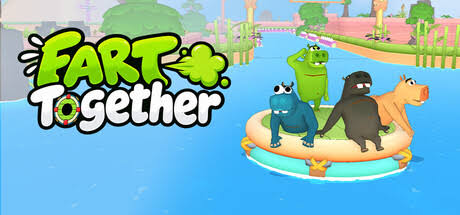
At first glance, Fart Together presents itself as a slapstick party game where players embody cartoonish hippos stranded on a circular inflatable raft, propelling themselves forward through flatulent outbursts. However, beneath this bawdy, comedic veneer lies a surprisingly punishing and mathematically demanding physics simulation. The game eliminates traditional, centralized vehicle controls—such as a single rudder, steering wheel, or uniform acceleration pedal—and instead distributes locomotive force across two to four independent human actors, each governing a single thrust vector tied directly to their individual avatar’s position, charge time, and discharge angle. As a result, movement becomes an exercise in real-time vector addition and rigid-body Newtonian dynamics, turning what appears to be a trivial party arcade title into a volatile crucible of kinematic coordination.
This article provides an exhaustive, granular investigation into a specific structural challenge that defines the core experience of Fart Together: the breakdown and mastery of co-dependent, physics-driven multi-agent propulsion. When multiple players apply asynchronous bursts of kinetic energy to a floating, low-friction object, even minor discrepancies in millisecond timing or directional alignment generate uncontrolled angular momentum. By dissecting the physical realities of rotational torque, fluid drag, airborne trajectory manipulation, and collective behavioral stress, we trace the full chronological lifecycle of a run—from pre-launch positioning to high-tier navigational mastery.
Phase 1: Pre-Launch Vector Allocation and Weight Distribution on the Shared Hull
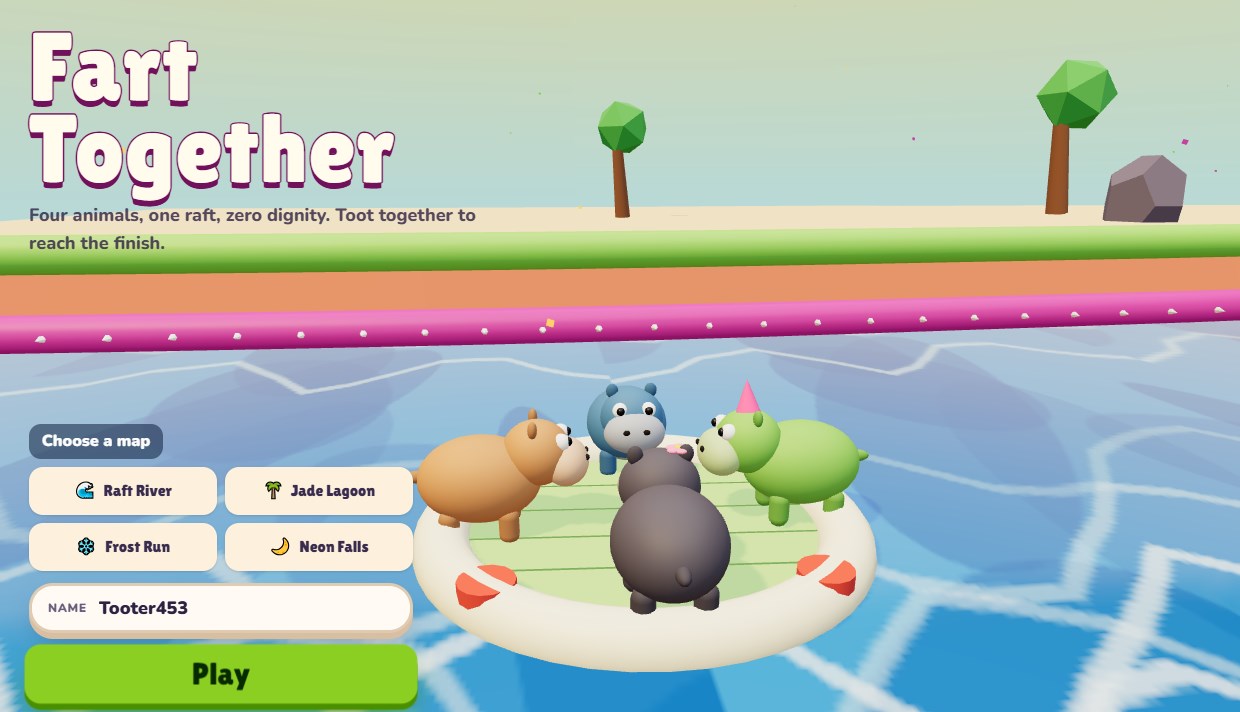
Before the raft ever touches a single kinetic vector, the physical baseline of the entire expedition is determined by the spatial configuration of the players on the raft’s perimeter. Fart Together treats the circular craft as a floating disk with a fixed center of mass and an evenly distributed buoyancy model. When players spawn, their physical avatars possess mass variables that subtly influence the tilt and center of gravity of the vessel. If two players bunch together on the starboard quadrant while the port side remains vacant, the raft incurs an asymmetric drag coefficient in the water simulation, causing baseline yaw drift even prior to active thrust discharge.
Establishing an optimal layout requires understanding how angular offset dictates rotational force versus forward drive. The mechanical foundation rests on vector decomposition across the floating perimeter:
Hull Geometry and Center of Gravity
The circular geometry of the raft means that every player's propulsion acts as a tangential and radial force applied at an offset distance from the centroid. Applying thrust along the normal axis of the raft’s boundary pushes the entire body linearly, whereas applying thrust at an off-angle introduces an immediate torque. Teams that fail to agree upon their perimeter assignments find themselves generating competing polar forces that cancel out linear velocity while maximizing unwanted spin.
Pre-Launch Positioning Checkpoints
- Symmetrical Quad-Lock: For four-player sessions, players must align at precise 90-degree intervals (North, East, South, West) to balance linear forward thrust with orthogonal lateral correction.
- Opposed Dual-Point: In two-player configurations, occupying antipodal points (180 degrees apart) is necessary to ensure that simultaneous discharges produce pure linear translation rather than chaotic rotational loops.
- Weight Neutralization: Ensuring players remain seated in their designated zones prevents unexpected shifts in hydrodynamic resistance before the countdown ends.
Failure at this foundational step compromises every subsequent maneuver. Because the water simulation calculates localized displacement based on hull tilt, an unbalanced crew will find their raft sluggish to respond to forward commands, compounding the difficulty of navigating the opening straightaways.
Phase 2: The Initial Impulse Phase – Thrust Synchronization and Deadzone Management
The initiation of movement from a dead stop exposes the brutal reality of static friction and initial inertia. In Fart Together, a player's propulsion mechanism is not an instantaneous binary switch; it incorporates a charge-up ramp and release curve. A short tap delivers a meager burst of kinetic energy with minimal exhaust duration, whereas a fully charged emission generates high-magnitude impulse at the cost of prolonged vulnerability and cooldown lag. The opening seconds of a run demand synchronized impulse initiation to break water inertia without initiating an immediate directional spin.
When all players release their charges simultaneously, the raft accelerates cleanly along the resultant vector. However, human reaction times inevitably introduce a latency variance ranging between 50 and 250 milliseconds. In a game governed by rigid-body physics, a 150-millisecond disparity between the starboard player’s exhaust and the port player’s exhaust causes the raft to pivot sharply on its vertical axis before the second burst can balance the equation. This unintended yaw instantly rotates the second player's discharge vector away from the desired forward trajectory, sending the vessel careening diagonally toward the track boundaries.
The Dynamics of Kinetic Desynchronization
The net acceleration of the raft is directly proportional to the sum of all individual thrust curves divided by the collective mass of the craft and crew. If the start times are staggered, the accumulation of unbalanced lateral forces generates immediate angular acceleration, spinning the craft around its moment of inertia. Once angular velocity takes hold, subsequent straight-line intentions dissolve into wild rotational spirals.
Phase 3: Navigating Early-Course Flow: Fluid Drag vs. Rotational Torque
Once the raft is moving along the primary waterway, players must contend with the interaction between forward hydrodynamic resistance and rotational torque. The water volume in Fart Together does not act as an idealized friction-free vacuum; it exerts dynamic viscous damping on both linear velocity and angular spin. The faster the raft travels, the higher the counter-force pushing against the bow. This mechanic forces players to constantly balance raw propulsive bursts with calculated micro-adjustments.
Crucially, steering in this game cannot be achieved through passive rudder deflection. To make a clean left-hand turn, the starboard players must produce more cumulative impulse than the port players, or the port players must angle their exhaust outward to act as an active counter-pivot. This dynamic creates a perpetual tug-of-war. If the inside player attempts to stop or brake, they risk anchoring that side of the raft, causing the outside edge to whip around with exaggerated centrifugal force.
Dynamic Vector Steering Protocols
Executing smooth cornering along wide river bends requires structured communication hierarchies. Rather than having all players act independently, teams must adopt specialized operational roles based on their physical placement on the raft:
Operational Crew Specialization
- The Primary Thrusters (Stern/Aft): Charged with maintaining baseline forward momentum through synchronized, metered discharges, ensuring the raft does not stall against water currents.
- The Rudder Specialists (Flanks): Responsible for micro-pulsing bursts at oblique angles to induce controlled yaw without shedding critical linear speed.
- The Spotter/Counter-Balancer (Bow): Tasked with scanning upcoming hazards, calling cadence, and executing emergency reverse-blasts to prevent head-on collisions with obstacles.
By compartmentalizing mechanical duties, teams significantly reduce the incidence of catastrophic over-steering, enabling the vessel to trace efficient parabolic arcs through early river bends rather than ping-ponging between shoreline barriers.
Phase 4: Mid-Course Choke Points: Managing Angular Momentum and Wall Collisions
As courses transition from gentle waterways to constricted canals, the margin for rotational error shrinks to near zero. Choke points in Fart Together feature protruding rock formations, narrow gated arches, and jutting barricades designed to exploit rotational momentum. If the circular raft enters a narrow passage while possessing even a minor residual angular velocity, its outer edge inevitably makes contact with the geometric collider of the canal wall.
Collisions in the game utilize elastic and semi-elastic physics interactions. When the raft clips a static boundary, the kinetic energy of the impact is instantly converted into sudden rotational spin. The collision acts as a fixed fulcrum: the point of contact halts abruptly while the unhindered side of the raft continues forward, violently whipping the craft around 180 degrees. In a split second, the players who were facing forward are now pointing backward, completely disorienting their mental spatial map.
The Wall-Bounce Cascade
The immediate physiological response of an inexperienced team facing a wall strike is panic discharge. Instinctively, players mash their input keys to propel themselves away from the danger. However, because the craft is in active spin, the physical direction of every player’s exhaust is spinning synchronously with the hull. Discharging thrust while under rotational acceleration applies fuel to the fire, turning a manageable scrape into a high-speed spin cycle that bounces repeatedly between opposing walls until all forward velocity is completely neutralized.
Phase 5: Dynamic Asymmetric Thrust: Correcting Drift in Turbulent Waterways
Beyond static level architecture, mid-tier stages introduce active environmental hazards such as crosscurrents, whirlpools, and localized water geysers. These hydrodynamic disruptions apply localized forces beneath specific sectors of the raft, breaking the symmetrical relationship between player inputs and vehicular movement. Traversing these turbulent sections requires an acute understanding of asymmetric thrust compensation.
In crosscurrents pushing from west to east, a team attempting to travel due north cannot simply point their exhaust south. The net vector sum of the lateral water velocity and the forward propulsion causes severe eastward leeway drift. To maintain a true path, the crew on the upstream side must sustain a continuous, low-amplitude output to counteract the lateral drift, while the downstream crew reserves their maximum charges for pure forward translation.
Managing Asymmetric Load
Maintaining asymmetric propulsion introduces severe cognitive load and gas gauge resource strain. The game’s recharge meter prevents infinite firing; exhausting a player's flatulent capacity induces a temporary exhaustion state characterized by an empty meter and sluggish mobility. If the upstream stabilizers deplete their meters simultaneously, the crosscurrent claims the raft, washing it off-course into environmental hazards or dead-end eddies.
Techniques for Navigating Lateral Turbulence
- Staggered Firing Rotations: Downstream players cycle their discharge cycles in alternating waves, ensuring that propulsive thrust never drops to absolute zero during high-current transit.
- Angled Crab-Crawling: Intentionally orienting the raft at a 45-degree angle against incoming rapids, allowing a single unified volley to simultaneously overcome current resistance and advance along the course axis.
- Momentum Hedging: Deliberately slowing forward pace prior to current entry to maximize lateral steering responsiveness and avoid overshoot errors.
Mastery of asymmetric stabilization transforms unpredictable water flow from an insurmountable hazard into a manageable operational condition, paving the way for the most complex kinetic maneuvers in the game.
Phase 6: Elevation Ramps and Airborne Ballistics: The Physics of Airborne Propulsion
The progression of Fart Together eventually forces the raft out of the water entirely, launching the crew into the air via steep wooden launch ramps and natural waterfalls. When the hull leaves the water volume, the physics model instantly switches from fluid buoyancy and hydrodynamic damping to pure Newtonian ballistic motion governed by gravity, projectile velocity, and atmospheric trajectory mechanics.
In mid-air, the physics interactions undergo a radical transformation. Without the stabilizing drag of the water surface, the raft's resistance to rotational acceleration drops dramatically. Thrust discharged while airborne does not encounter friction; instead, it delivers immediate, unbuffered kinetic impulse. A single mistimed emission mid-flight will not merely nudge the raft—it can cause the entire craft to tumble along its pitch and roll axes, flipping the raft upside-down before it touches back down on the water.
Mid-Flight Vector Correction
Landing an upside-down raft results in an instant wipeout, ejecting players and forcing a checkpoint reset. Consequently, airborne sections demand supreme spatial awareness and discipline. Players must resist the urge to boost for raw distance unless the raft is perfectly level. Airborne propulsion must be strictly reserved for pitch stabilization: if the bow pitches downward dangerously toward the water surface, the forward players must execute precise, millisecond-scale micro-blasts downward to pitch the craft back to a horizontal attitude prior to splashdown.
Phase 7: The Cascade Failure Dilemma: Overcorrection, Panic Discharges, and Desynchronization
The most fascinating psychological and mechanical phenomenon in Fart Together is the Cascade Failure Loop. This occurs when a minor operational error triggers an instinctual overcorrection, which creates a larger error, ultimately cascading into total operational collapse. This progression illustrates the fragility of co-dependent control systems where no single operator possesses autonomous authority.
Consider a typical scenario: the raft drifts slightly right of the intended line. The left-flank player notices this and discharges a blast to correct course. Simultaneously, the right-flank player notices the exact same error and attempts to help by holding back their planned discharge. The result is an aggressive leftward hook. Witnessing this sudden shift, both players panic: the right-flank player discharges a full-power blast while the left-flank player tries to brake. Because their reactions are driven by chaotic instinct rather than structured feedback, they constantly correct for where the raft was a half-second prior, rather than where it will be when their thrust actually manifests.
Anatomy of a Team Spiral
The failure spiral unfolds across three distinct psychological and mechanical stages:
Stages of Breakdown
- Latency-Induced Panic: A minor positional error leads to overlapping, contradictory corrective inputs from multiple players without verbal pre-planning.
- Mechanical Desynchronization: Players exhaust their propulsion meters at opposing cadences, leaving the raft with zero directional authority when an actual hazard approaches.
- Total Acoustic Chaos: Voice communication deteriorates into mutual blame, panic shouting, and auditory masking, making coordinated countdowns impossible and guaranteeing a course wipeout.
Escaping this destructive loop requires one player to assume absolute commanding authority, calling an immediate all-stop where every participant ceases fire, absorbs the minor wall impact, and resets their physical orientation from a stationary baseline.
Phase 8: Late-Course Obstacle Traversal: Slalom Hazards and Timed Environmental Sweepers
Approaching the final sectors of high-difficulty levels, the game introduces moving hazard sequences: sweeping pendulum logs, crushing hydraulic gates, and high-speed slalom courses flanked by explosive buoys. Here, continuous linear speed is an active liability. Survival mandates erratic, highly technical maneuvers combining rapid forward acceleration with instantaneous, dead-stop deceleration and sharp lateral dodges.
To execute a tactical emergency brake in Fart Together, players must reverse their internal mental axes. Because there is no mechanical brake pedal, stopping can only be achieved by players pointing their avatars toward the direction of travel and discharging their propulsion directly against incoming velocity vectors. If the raft is rushing toward a closing gate at high speed, the forward-facing crew members must fire forward with absolute simultaneous timing. Any asymmetry in this counter-thrust will cause the raft to pirouette violently into the very obstacle they were attempting to avoid.
Slalom Path Optimization
Slalom courses require teams to establish a persistent kinetic rhythm known as the S-Curve Alternation. Rather than attempting to hold a steady course and steering around buoys at the last second, optimal teams initiate deliberate, rhythmic yaw oscillation. By maintaining continuous, alternating bursts between left and right flanks, the raft weaves through tightly spaced gates like a downhill skier, using angular momentum constructively rather than constantly fighting against it.
Phase 9: Fatigue, Latency, and the Psychological Strain of Mutual Accountability
The late-game environment tests not only motor execution and spatial geometry, but also human endurance and interpersonal communication resilience. Because a run in Fart Together can last several minutes of unbroken, high-tension maneuvering, cognitive fatigue rapidly degrades mechanical precision. Finger fatigue can introduce input stutter, while mental processing delays cause players to miss visual hazard cues by fractions of a second.
Furthermore, the game’s co-op infrastructure is inherently vulnerable to network latency in online multiplayer lobbies. In a client-server architecture running rigid-body synchronization, a 50-millisecond latency spike on one player’s connection can desynchronize physics ticks. If the host processes a fart burst earlier than client machines reflect, the resulting angular torque calculation will register differently across systems, requiring aggressive server-authoritative positional corrections. This network jitter manifests in-game as sudden, micro-teleportation hops that throw off delicate timing windows.
The Psychology of Shared Blame
Unlike asymmetric cooperative titles where players hold independent roles (such as a sniper covering a runner), Fart Together traps every participant in the exact same physical vessel with identical mechanical agency. Every failure is visibly shared, yet identifying the exact culprit of a bad vector is notoriously difficult. Did the raft hit the left wall because Player 1 fired too early, or because Player 3 failed to fire as a counterweight? This inherent ambiguity fosters friction, forcing teams to develop psychological cohesion, clear callouts, and emotional resilience to maintain focus across extended play sessions.
Phase 10: The Master Run: Emergent Synergies, Micro-Bursts, and Optimized Pathing
When a team finally achieves mastery over the chaotic propulsion model of Fart Together, the gameplay transforms entirely. What begins as an uncontrollable bumper-car debacle matures into a mesmerizing, high-precision demonstration of collective kinetic navigation. Master-tier runs exhibit an elegance where verbal communication often fades entirely, replaced by intuitive musicality and shared environmental rhythm.
Top-tier teams abandon the crude tactic of holding full-charge blasts, relying instead on high-frequency micro-bursting. By rapidly delivering minimal-charge pulses, players retain continuous, real-time control over their thrust vectors without ever locking themselves into long recovery animations or depleting their gas meters. This micro-burst methodology creates a stabilizing gyroscopic effect: tiny, opposing bursts keep the raft floating along a knife-edge trajectory, effortlessly skimming within millimeters of lethal boundaries without a single scrape.
Tactical Innovations of Elite Crews
Advanced play reveals hidden emergent strategies made possible by the game’s deep physics simulation:
High-Skill Navigational Mechanics
- Raft-Drifting: Deliberately initiating high angular velocity around sharp river bends, followed by an immediate multi-agent blast along the exit tangent to whip the vessel out of the corner with amplified exit speed.
- Vector Pinching: Two adjacent players aiming their exhaust inward toward an imaginary shared intersection, creating a synthesized, hyper-concentrated directional impulse that outperforms parallel individual firing.
- Airborne Recoil Balancing: Calculating precise ballistic drop points over chasms and utilizing rapid airborne micro-pops to cancel out downward vertical velocity just prior to water impact, avoiding deep hull submersion and speed bleed.
Ultimately, Fart Together stands as an extraordinary mechanical case study in modern indie game design. Beneath its irreverent theme and fart jokes lies an unapologetically complex, zero-tolerance physics system that demands uncompromising cooperation, spatial literacy, and mathematical alignment. It proves that with enough kinematic nuance, even the most absurd premise can be leveraged into a rigorous test of human synchronization.
Conclusion: By replacing traditional unified steering with distributed, individual vector physics, Fart Together transforms cooperative play into a challenging simulation of kinetic torque and dynamic momentum. Success requires overcoming human latency, mastering fluid and aerial dynamics, and cultivating total crew coordination. In doing so, players elevate a comedic slapstick trial into an impressive showcase of emergent navigational mastery.
Mastering Fart Together requires balancing kinetic torque, fluid drag, and synchronized vector thrust to turn chaotic multi-agent propulsion into true precision.