




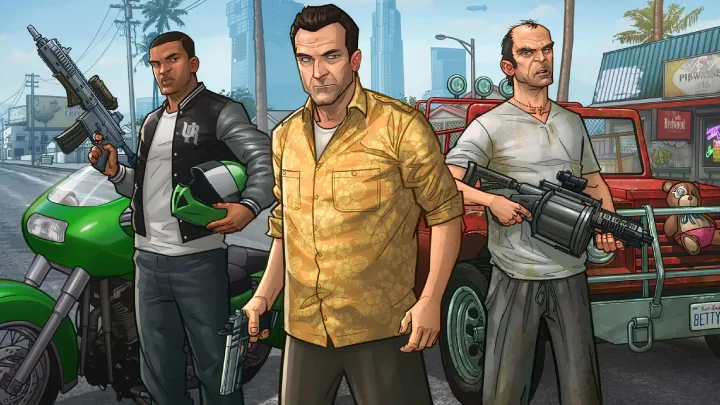
Grand Theft Auto V is a sprawling sandbox where crime, storytelling, and emergent systems collide. Beneath the high‑octane heists and cinematic missions lies a persistent, player‑shaped economy that affects choices from which car you buy to which businesses you invest in during the single‑player Campaign and in GTA Online. This article focuses narrowly on one specific issue: how money—its acquisition, sinks, and perceived value—structures player behavior and design decisions in both GTA V’s story mode and GTA Online. We will trace the economic lifecycle through ten ordered stages: from early earnings and risk‑reward calculus to endgame accumulation, laundering, and the psychological cost of virtual wealth. Each section contains two to three paragraphs that inspect mechanics, player psychology, design intent, and practical implications. Where applicable, I include subheadings and lists to make the analysis actionable for players and useful for designers studying virtual economies.
Early income and the framing of value
At the outset of GTA V’s single‑player Campaign, the game trains players to see money as a scarce, precious resource. Early missions reward small sums that are meaningful—paying for weapons, better armor, and vehicle repairs. This scarcity shapes choices: do you purchase a suppressor to approach stealthily, or save for a high‑performance vehicle? The framing here is deliberate; Rockstar tightens resource availability early to make each acquisition feel impactful, which in turn heightens engagement with mission systems and side activities.
In GTA Online the early economy is more permissive but still carefully gated. Starter cash is low relative to desirable items, and the game nudges players toward jobs, races, and heists. The initial scarcity creates a behavioral baseline: players learn the grind and internalize what “affordable” looks like. Designers exploit this by sequencing unlocks and by introducing aspirational items—luxury apartments, sports cars, weaponized vehicles—that refract long‑term engagement into short‑term microgoals, increasing retention and guiding behavior without explicit directives.
Why scarcity matters
- Creates meaningful decisions: each purchase becomes a tradeoff that signals player priorities.
- Encodes progression: early scarcity makes later abundance feel rewarding.
Income diversification: missions, side content, and exploitation
Once players have grasped basic mechanics, the question becomes how to optimize income streams. In story mode, investments (stock market manipulation via Lester’s assassination missions) provide a deep, scripted diversification opportunity: successful players can create exponential wealth through timed kills and careful market observation. This mechanic cleverly ties narrative actions to economic payoff, rewarding players who understand both lore and market mechanics.
GTA Online multiplies income channels—heists, VIP work, contact missions, adversary modes, CEO/MC businesses, races, and daily events. However, diversification is complicated by returns: some activities (heists) have high per‑hour yield but require coordination; others (headshot challenges, daily objectives) are low yield but repeatable solo. Players rapidly develop heuristics: what to do solo versus with a crew, what tasks scale with player skill, and where time investment yields diminishing returns. These player heuristics often drive meta‑behavior—what is farmed, what is ignored, and which activities get seasonal buffs or nerfs by Rockstar to rebalance the economy.
Income channels ranked by expected return (generalized)
- High return, high coordination: Heists (Cayo Perico first, Pacific Standard historically)
- Moderate return, scalable: CEO/MC businesses, bunker and hangar work
- Low return, solo‑friendly: Contact missions, races, daily objectives
Risk versus reward: heists, contraband runs, and the psychology of high stakes
A core appeal of GTA V’s economy is the dramatic asymmetry between high‑risk, high‑reward activities and low‑risk grinding. In single‑player, assassination missions let players dramatically alter their net worth—if they act strategically. In online play, heist finales, Cayo Perico raids, and import/export runs offer large single payouts but require time, coordination, or stealth. The presence of such spikes biases player behavior: many players prefer to repeatedly play the same high‑payout loop (e.g., Cayo Perico solo runs), while others prioritize variety.
Psychologically, large, infrequent payouts create stronger memory and satisfaction than many small rewards (the “peak‑end rule” in behavioral economics). This explains why players often measure success by a few massive windfalls (stock manipulation in story mode, big Cayo runs in Online). Designers leverage this by ensuring there are ever‑present opportunities for big hits—keeping the dream of a single “life‑changing” payout alive encourages continued engagement.
Design implications
- Maintain at least one reliable high‑payout activity to keep player motivation high.
- Offer alternatives for time‑poor players (solo high‑payout runs) versus full crews (coordinated heists).
Money sinks and inflation: how Rockstar controls perceived wealth
Virtual economies need sinks: places where money exits circulation, countering inflation and sustaining challenge. GTA V’s money sinks include property purchases, vehicle upgrades, weaponry, customization, and mission costs (bailouts, repairs). In Online, cosmetic items—clothes, tattoos, apartment decoration—function as soft sinks, while expensive vehicles and weaponized upgrades act as hard sinks. The balance between these sinks and money inflows determines whether players feel wealthy or perpetually short.
Rockstar periodically introduces exotic, ultra‑expensive items (e.g., weaponized vehicles, the Kosatka submarine, the Terrorbyte) that temporarily elevate the cost floor and recontextualize wealth. When new high‑end items enter the market, previously affordable items lose their prestige, resetting the economy's social scale. This tiered introduction is a deliberate inflationary mechanism that drives continued play: to regain status, players must farm or spend. The trick is to calibrate sinks so they’re meaningful but not punitive—when everything costs “too much,” engagement drops.
Typical money sinks
- Hard sinks: vehicles, properties, businesses, weaponized upgrades
- Soft sinks: cosmetics, liveries, tattoos, apartment decor
- Periodic sinks: limited‑time bundles, business expansion updates
Laundering, legitimacy, and the narrative of money laundering in single‑player
GTA V’s story mode explores money’s narrative role—especially via laundering, investments, and legitimacy. Michael’s and Franklin’s plans with stocks and property expose players to “legalized” schemes: use criminal acts to manipulate markets, then cash out through seemingly legitimate channels. This creates a sharp distinction between raw in‑game cash (often traceable to violent acts) and socially accepted wealth (cleaned via investments).
From a design standpoint, laundering mechanics serve several functions: they provide structured long‑term goals, they connect narrative to gameplay, and they teach players to think about the economic consequences of actions. For designers, it’s a useful lesson—integrating economic mechanics into storylines deepens immersion and rewards strategic thinking beyond shooting or driving skill.
Narrative effects
- Money becomes a plot device, not just a resource meter.
- Laundering mechanics teach long‑term planning and strategic timing.
Social signaling: wealth, display, and status in GTA Online communities
Money in GTA Online is not only a resource; it’s a social signal. Players use cars, apartments, weaponized vehicles, and exclusive cosmetics to signal status and playstyle. These signals influence group composition (who is invited to a crew), interactions (who is targeted in PvP), and social hierarchies (in‑game leaders or prominent streamers attract followers). Ornamentation choices are strategic: a wealthy player may adopt subtle displays of wealth to avoid becoming a high‑value target, or flaunt their status to assert dominance.
Social signaling can lead to emergent economies—fads where certain cars or outfits become visible markers of taste. Rockstar’s limited‑time offers and event rewards often create tiered fashions. The interesting dynamic is that signaling is self‑reinforcing: as more players adopt a style, its prestige can decline, prompting new fashions and continuous purchasing—another form of indirect money sink.
Signaling behaviors
- Display signals: supercars, penthouses, weaponized vehicles
- Concealment strategies: low profile vehicles, minimal cosmetics to avoid targeting
- Fads and fashions: community‑driven trends that influence buying decisions
Exploits, duplications, and the fragility of virtual economies
No virtual economy is immune to exploitation. Duplication glitches, money exploits, and scripting in GTA Online have periodically inflated player balances, destabilizing economy and reducing the perceived value of money. Rockstar’s responses—bans, rollbacks, hotfixes—are damage control, but the underlying fragility remains: when players can shortcut labor, the perceived fairness of the economy collapses.
Designers can mitigate exploit risk through several systemic choices: limit single‑transaction caps for high‑value items, monitor economic telemetry for suspicious spikes, and design “graceful” sinks that make exploits less tempting. Another long‑term strategy is to design many small, achievable status markers rather than a few ultra‑costly items; this reduces the incentive to exploit for a single massive prize.
Common exploit consequences
- Inflation of status items value → diminished prestige
- Increased player churn due to perceived unfairness
- Reactive policy overhead for developers (rollbacks, bans, patching)
Time investment, grind, and the economy of boredom
Economists studying virtual worlds refer to “time sinks”—mechanics that deliberately require repeated labor. GTA Online’s grind serves dual purposes: it spaces progression to extend engagement, and it monetizes impatience (players buy Shark Cards to accelerate progress). There’s a fine balance: grind should feel meaningful and skillful; when it becomes monotonous repetition without reward variance, players experience burnout and churn.
Designers must treat grind as content design: provide variety, meaningful milestones, and a sense of progress even during routine tasks. GTA Online’s introduction of heists, daily objectives, and weekly events is a way to disrupt grind cycles and reframe repetition as emergent goals. From a player perspective, time investment decisions involve opportunity costs: are you willing to grind twenty hours for a luxury vehicle or pay to acquire it quickly? The answer depends on player type—completionists will grind, social players may pool resources, and convenience buyers will purchase currency.
Reducing grind fatigue
- Add varied tasks and mini‑goals within grind loops (e.g., cosmetic unlocks)
- Offer alternating high‑reward events that break monotony
- Provide incremental recognition: small, frequent rewards alongside large milestones
Design lessons: what GTA V teaches about persistent economies
GTA V and GTA Online offer several lessons for designers of virtual economies. First, tie economic mechanics to meaningful gameplay—investments, heists, and stock manipulation are engaging because they connect to player agency. Second, maintain a balance of money inflow and multiple sinks to avoid runaway inflation while preserving a sense of advancement. Third, value diversity of income sources—this caters to different player types and reduces single‑point exploit incentives. Fourth, design social signaling and status systems deliberately, knowing they will generate emergent trends and secondary markets.
Finally, manage psychological hooks intentionally: periodic high‑payout opportunities, aspirational cosmetic drops, and narrative ties keep players invested. But ethical considerations matter—designers should avoid predatory time‑sinks that force pay‑to‑win dynamics, and should transparently address exploits and economy‑breaking issues when they arise. Rockstar’s long‑running experience demonstrates both the resilience and the vulnerabilities of large live economies; their iterative approach—patches, content, and community engagement—provides a pragmatic roadmap for other live‑service titles.
Practical takeaways for designers
- Integrate economics into narrative where possible.
- Provide both soft and hard sinks to maintain balance.
- Monitor telemetry for early exploit detection and be transparent with the community.
Conclusion
Money in Grand Theft Auto V and GTA Online is far more than a numerical gauge of success: it is a behavioral engine, a narrative device, a social signal, and a design lever. From early scarcity that teaches value to sophisticated money‑making loops that reward strategic play, economic systems shape player decisions at every scale. Rockstar balances inflows and sinks, introduces aspirational items to reset social prestige, and leverages psychological rewards to sustain engagement. Yet fragility remains—exploits and inflation can quickly undermine systems, so active stewardship is necessary. For players, understanding the economic mechanics—how to diversify income, where to invest, and how to time heists and market plays—transforms gameplay from moment‑to‑moment action into a strategic long‑term endeavor. For designers, GTA V serves as a masterclass in integrating economy and play, with cautionary notes about the costs of imbalance and exploitation.
Summary
GTA V’s economy shapes player choices: scarcity, income diversification, money sinks, social signaling, and exploit risks create a complex virtual market requiring careful design.