
Someone at the Gate: Lucia’s Ride Home in Grand Theft Auto VI
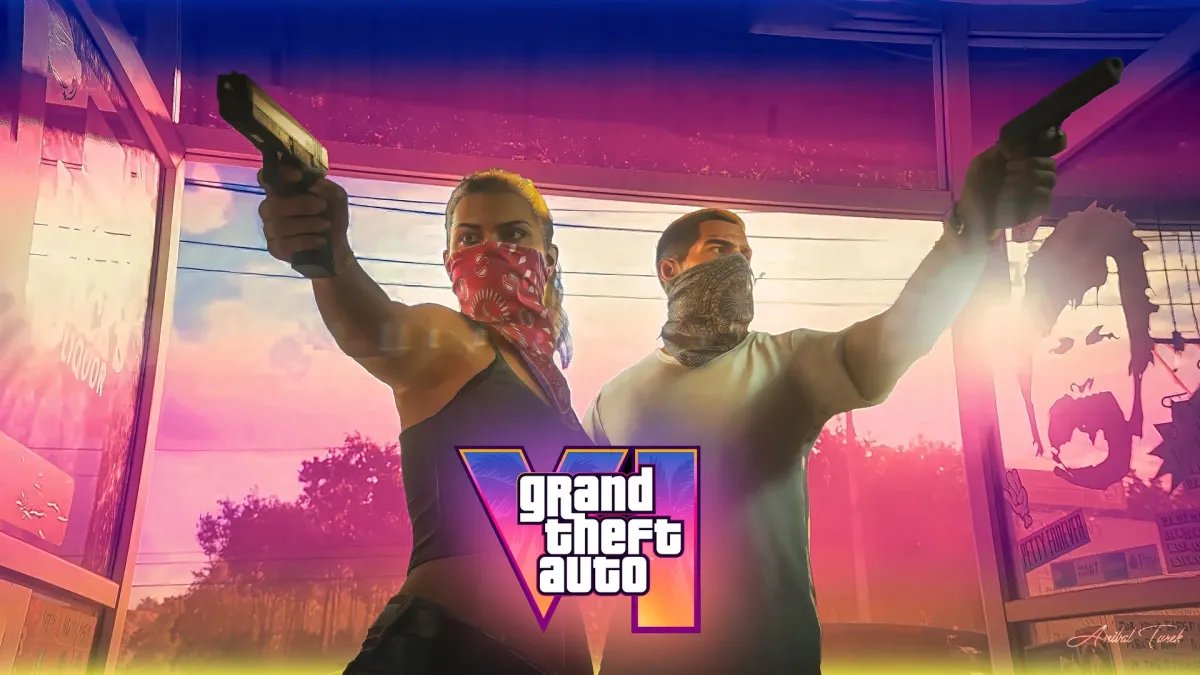
Jason Duval goes to prison with a perfectly bureaucratic sentence ready. “I’m here for Lucia Caminos.” He gives the woman at the counter enough information to look up a name. He also says, in the plainest words available to him, something Lucia might reasonably want to hear. The trouble is that she’s still inside. By the time she can see him, the sentence has become unnecessary. He’s there. Rockstar builds the reunion in the second Grand Theft Auto VI trailer around that interval between speech and proof. It lasts a few seconds, about as long as it takes to recognize somebody across a parking lot. Yet nearly everything the trailer subsequently asks us to believe about these two people depends on what happens in those seconds. A robbery can demonstrate that Jason and Lucia work well together. Picking somebody up on release day poses a more intimate question. Whose face did she hope would be waiting?
Lucia gets the first word about her sentence
The pickup has a beginning in the first trailer, well before Jason pulls up. Lucia looks out through a prison window. People in orange occupy the yard beyond it. Then a woman sitting across from Lucia asks whether she knows why she’s there. It’s a peculiar question to put to someone in custody. Both women presumably know the answer that could be supplied by a file. What the question calls for is a performance of understanding. Lucia is being invited to explain herself in terms her listener will recognize. She gives the woman two words, “Bad luck,” and leaves her to do what she likes with them. It’s a good joke, partly because the answer would be equally appropriate from someone who believes herself innocent and someone chiefly aggrieved at having been caught. Lucia can be frank about her feelings while keeping the facts of her life to herself.
In that pause lies the difference between knowing Lucia’s situation and knowing Lucia. We have seen enough orange clothing and wire to recognize a prison. We might even feel entitled to the story of the offense after being placed across a desk from her. Her answer makes that entitlement a little embarrassing. Why should the stranger watching a game trailer get a fuller confession than the person asking the question? A familiar way of introducing a crime protagonist would be to show the deed, the arrest and the door closing, in that order. Here the door has already closed, and the woman inside retains some say over what the audience gets to take away. Later, when the trailer campaign returns to prison from Jason’s side of the fence, this early encounter matters. Somebody the viewer already knows is on the other side. She had a sense of humor before he came to get her. She also had perfectly good reasons to save some of it for better company.
The family history behind her answer
Rockstar’s character portrait of Lucia gives her remark about luck a family history. Her father taught her to fight when she was little. Fighting for her family eventually put her in the penitentiary. Her mother, meanwhile, has been imagining a better life since their time in Liberty City. Those details belong together. One parent passed on something a child could learn with her body, a way to meet an immediate threat. The other passed on a desire with no obvious means of fulfillment. A daughter might become extremely good at the first inheritance without getting an inch closer to the second. In fact, following one to its conclusion has put Lucia behind a fence. Her little joke at the interview desk grows considerably sadder in this light. What sounds like a refusal to take responsibility could equally be impatience with the idea that a stranger could understand what she owes her family from a recital of the charges.
Consider what this does to the prospect of a man arriving to take her home. In a thinner romance, finding the right man would supply the heroine with a future at precisely the moment she needs one. Lucia has a future in mind already. She can measure Jason against a hope older than their relationship and against a much more recent memory of the price of doing something for love. That makes her welcome at the gate an interesting act of judgment. Letting somebody help is an entirely different use of the skills her father gave her. It requires her to identify a moment in which she can lower her guard and to recognize the particular person for whom she wants to do it. The trailer gives the viewer a face to study when the moment comes. Its warmth carries weight because there are people besides Jason, and years besides this one, to whom Lucia’s choices matter.
Jason starts his day on somebody else’s roof
When the second trailer turns to Jason, he’s above ground level in the Leonida Keys, fixing leaks. It’s a lovely place to be stuck doing maintenance. From the roof he has the kind of view a visitor would pay for, while Brian Heder can carry on a conversation from his truck below. The exchange has the loose familiarity of men who can interrupt each other’s mornings without an appointment. Then there’s the small matter of who owns the house. Brian lets Jason live at one of his properties in exchange for helping him collect on local obligations. That arrangement gives the scene a second audience. A man talking to a friend about a leaking roof is also a tenant visibly at work on his landlord’s investment. Even the question of whether Jason is on his own time gets surprisingly difficult to answer. The view is his to enjoy for as long as Brian is happy with the arrangement.
The address he can offer Lucia
A roof is a shrewd place to introduce the person who will collect someone else from prison. There’s an implicit promise in such a pickup that goes beyond transport. The driver has some idea of where the two of you can go. Jason can offer Lucia a place in his life, and the first thing we learn about that life is that the weather gets in. I like the modesty of the repair. It puts his competence on a human scale. A leak can be attended to this morning even if ownership of the property will never be within his reach. It also gives the later reunion a question that a glamorous exterior shot of a beachfront home would have settled too easily. What would it mean for Lucia to make herself at home in a place where Brian can turn up and ask Jason for a favor? The debt attached to the house will cross the threshold with them. For now, Jason can at least do something about the roof.
A cash register makes a poor rehearsal for the visitors’ desk
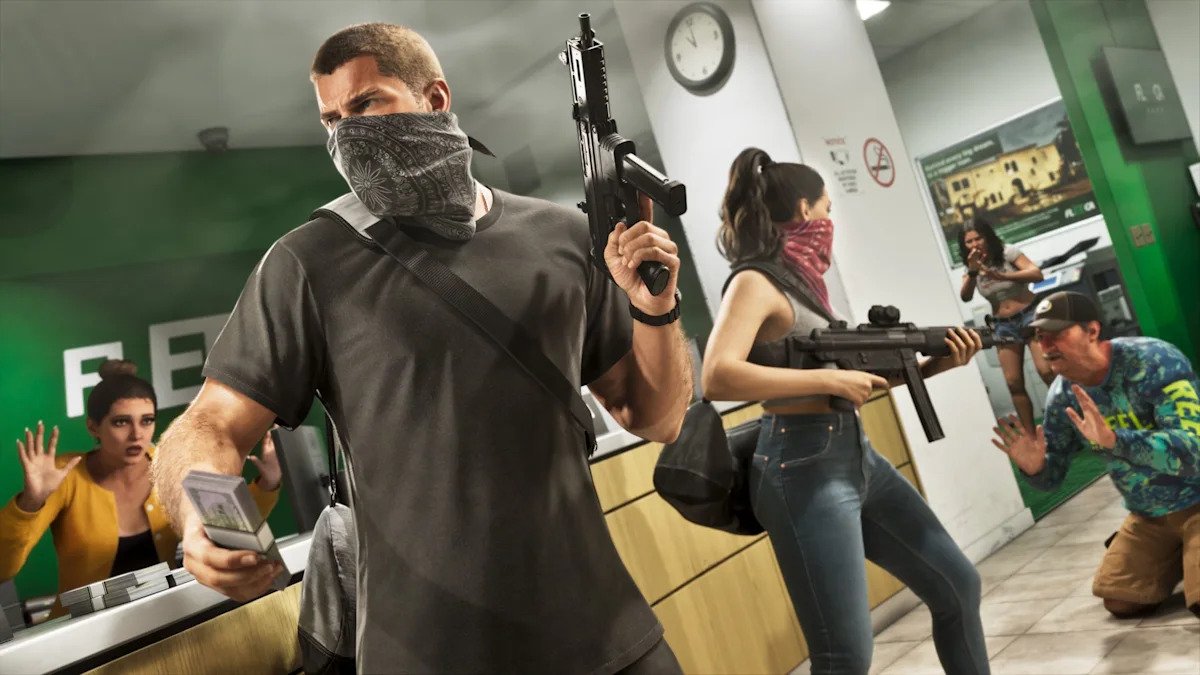
Between the roof and the prison, the trailer cuts through several versions of Jason. One drives, another works out in the open air, another has business to conduct at a shop counter. The cut to the cash register is startlingly blunt. Here’s a man who can turn a piece of everyday commercial furniture into the site of an ugly confrontation. Because we’ve just met Brian, the errand carries an implication the trailer scarcely needs to explain. Somebody farther up the chain can enjoy the comfortable familiarity we saw at the house because someone like Jason is prepared to make a conversation uncomfortable elsewhere. It’s easy to like his easy manner on the porch. The shop gives the person on the other side of his charm a turn and makes it harder to assume that the visitor Lucia is waiting for will be equally good news to everyone he meets.
Keep that register in mind when Jason arrives at a second counter. The pieces of furniture do much the same job. They divide two people who need to transact some business and establish which side has access to the thing being requested. What changes is Jason’s sense of what he can get away with. At the penitentiary, the woman behind the counter can ask him a personal question, and his most effective response is to keep things pleasant. He’s perceptive enough to understand where he stands in both rooms. That quality makes him an appealing person to have in your corner and a distinctly worrying one to have across from you. Lucia’s ride therefore arrives with a harder question than whether a tough man can be gentle with the woman he loves. Of course he can. What will the two of them do when the arrangements that allow them a little gentleness at home require one of them to go out and be frightening again?
The road runs up against a fence
Road footage is an unusually efficient form of persuasion in Grand Theft Auto. A driver sees a sign dividing traffic between destinations. A viewer starts mentally making the turn. The second trailer lends us the view through the windshield, and for a moment the geography feels available in every direction. The prison changes the meaning of all that driving. Jason has an appointment. Once we learn where he’s headed, the various images of a man getting through his day acquire the pull of a particular place. They needn’t represent successive turns on a continuous route for the effect to work. It’s enough that the edit finally takes us somewhere where possession of a car counts for very little. Jason can arrive under his own power. The last few yards of the journey depend entirely on somebody opening up from the other side.
The first trailer had offered a view of the grounds from within. A yard stretching into the distance must feel like a particularly mean kind of scenery when your access to it depends on a schedule. Coming from Jason’s direction, the tower and the fence look different. They tell an approaching driver where he must stop, and they tell the viewer roughly where to look for Lucia. Put those two views together and the same land has two quite distinct sizes. It has taken a fraction of the trailer for Jason to travel between neighborhoods. Lucia has spent the length of our acquaintance with her trying to get to the far side of one fence. Here the game’s abundance of highways and vehicles acquires an emotional use. You can only appreciate how far apart these characters have been once you understand that ordinary distance is a lousy measure. From either side of the wire, the other person could be close enough to recognize and still be impossible to reach.
At the window, Jason gives her full name
Listen to the surname in Jason’s request. Somebody who knows Lucia well enough to collect her still needs to say “Caminos” to a stranger. At this window she belongs to an alphabetical system. Jason plays along with its requirements quite naturally, and for a few seconds the viewer gets the odd pleasure of watching a crime protagonist try to be an entirely satisfactory member of the public. He wants the woman at the desk to understand him on the first try. There is tenderness in knowing the correct thing to say on someone else’s behalf and then simply getting on with saying it. Plenty of stories give a lover a big speech explaining how far he would go. Jason gets a much less flattering opportunity. He has to be legible to a woman doing her job, who is under no obligation to find his errand poignant.
A face the clerk might know
Then the woman thinks she recognizes him. His little acknowledgment allows the suggestion to stand, leaving the circumstances of any previous meeting open. An elaborate denial would give her a reason to keep looking. An elaborate explanation would oblige him to surrender more of himself than the business at hand requires. His reply has roughly the same footprint as Lucia’s answer about luck in the earlier trailer. Both know how to give someone in an official position a conversationally adequate response and keep the interesting part for themselves. It’s the first convincing evidence in the prison sequence that these two might actually enjoy each other’s company. They share an ear for the point at which an answer can end. And there’s a good, slightly sour joke in the clerk’s curiosity. The institution needs a full name to find the woman Jason knows intimately. For the man volunteering that information, a half-remembered face is apparently quite enough to raise a question of its own.

Outside, Jason has to wait for his scene partner
At the gate Jason runs out of things to do. That’s a fairly drastic change for somebody the edit has kept so busy. Even lying on a bench at the beach involved a barbell. Now the audience has caught up with his intention, the clerk has heard him out, the building has been identified, and none of that produces Lucia any faster. Waiting is a particularly revealing occupation for this man because it’s the first one he can’t perform better by being strong, quick or persuasive. He can arrive on time. He can be visible when she comes through. After that, everything interesting belongs to somebody else. The trailer allows us just enough of that dead interval to feel the distance between a man who has undertaken an errand and a woman who is about to discover whether he kept his word.
The few seconds the editor could have taken out
Imagine cutting straight from the counter to the two of them already together. The audience would lose no essential piece of plot. Jason came for Lucia, the staff released her, and the couple left. It would lose something more peculiar, the chance to feel him briefly occupying a position she knows far better. He has to accept another person’s timing. The resemblance is momentary and wildly unequal, as he could get back in his car whenever he pleased. That difference gives his waiting its value. He’s chosen to give up a little control over his day in order to be there when she gets some control over hers. There is also a risk specific to any reunion. A person can spend the journey imagining what the other will say and still get the greeting completely wrong. The gate makes a fine physical device for holding those competing versions of the future apart. On this side stands a man who has done everything necessary to see Lucia and still has no idea exactly what seeing her will feel like.
Lucia sees who came for her
Lucia walks out in a dark shirt with her hair cut short. For a moment the fencing is still plainly visible behind her. Her smile arrives in a setting almost comically ill-equipped to flatter it. A sunset in the Keys can do half the emotional work of a romantic encounter before either person has decided how to feel. Chain-link offers the actors considerably less assistance. We look at her to find out what kind of meeting this is going to be. That matters because Jason has occupied so much screen time on his way here. The direction returns the judgment of his conduct to the person in a position to make it. He can get himself to the prison and tell a clerk what he’s come for. Only Lucia can supply the expression that makes his presence welcome. Her entrance settles that question with an economy the previous minute has taught us to associate with both of them.
The distance each person covers
There are two movements worth distinguishing. Lucia comes out under her own power, and Jason moves to meet her. Each covers some of the space left between them. A version in which he strode up and swept her away could be made to look more spectacular, but it would give all the interesting decisions to the person who already had a car, a home and a morning of his own. The actual staging gives her a little time in possession of the frame. She can see him before we have to start thinking about them as a couple. It’s an ordinary courtesy, almost too small to discuss, except that the first image of her in the campaign made such an issue of where she was allowed to look. Then she could see a yard full of people and couldn't choose to join them. Here she looks, recognizes someone and can close the distance if she wants. That sequence of tiny liberties gives the scene its joy. She gets to finish an action that began in her own head.
The dock gives the parking lot a future
Later in the trailer Jason and Lucia appear together with drinks, and the edit gives them time on a dock. The resemblance to the reunion is easy to miss amid everything else going on. Once again, two people are doing very little near the edge of a piece of ground. At the prison, a third party controls when they can occupy the same space. On the dock they have apparently found an interval they can spend just sitting beside each other. That’s about the smallest credible sample of the better life that Lucia might have in mind. It has an advantage over the expensive pleasures with which Vice City advertises itself. We already know exactly what it cost these two to get within conversational distance. A shared drink can register as a considerable luxury when the audience remembers the last person Jason had to talk to before he was allowed to see her.
The edit refuses to let that evening monopolize the meaning of their reunion. It also shows Lucia armed during a robbery. Other people now have reason to pay very close attention to what she wants, much as the person at the shop had reason to pay attention to Jason. The comparison is uncomfortable in a productive way. Knowing the smile at the gate makes it possible to care what becomes of the woman holding the weapon. Knowing what it means to have your movements governed by someone else makes it harder to dismiss the people facing her as scenery. Neither impression cancels the other. This is where a trailer can do something a cleanly chronological account would struggle to achieve. A beer, a gun and an evening by the water can sit close enough together for the viewer to feel a moral difficulty without anybody in the scene having to deliver a verdict. The couple have found a little time they can call their own. Other people may have quite different memories of the day that paid for it.

Conclusion: What a ride home can promise
By the time Jason calls her “Lu,” the difference from “Lucia Caminos” is audible. He needed the surname when he was explaining why he had come. He can use the short name when the person he wants to reach can hear him directly. A whole relationship fits inside that change of address, including parts of it the viewer will never reconstruct from these trailers. That’s one reason the pickup survives the much louder business that follows. Rockstar can enlarge the stakes to the scale of a criminal conspiracy across Leonida, and there’s still a precise point of reference for what it means to these people to rely on each other. We know what Jason looks like when his contribution consists of turning up. We know what Lucia looks like in the instant she discovers he has. If the story later asks either person for more, the audience has a modest, persuasive reason to believe the request will be heard.
My favorite thing about the sequence is the smallness of what Jason can honestly claim to have accomplished by the end of it. He didn’t give Lucia back the time she spent inside. He hasn’t secured the roof over their heads, settled what either of them owes their families, or made himself the kind of man whose face will never ring a bell at a prison counter. A ride home can’t carry that much weight, and Lucia seems far too intelligent to mistake it for a guarantee. What Jason has done is change one concrete detail of a day she will remember. Whatever else waited for her in Leonida, she didn’t have to walk out and search the parking lot for a way home. Somebody had already made the trip in the other direction. For all the pleasure Grand Theft Auto takes in putting its audience behind a wheel, the most affecting view of this particular journey belongs to the woman who sees, at the end of it, who came.